
How Minecraft Helps AI Master The Real World
A large-scale social experiment without any humans involved: in the blocky world of Minecraft, an experiment conducted by AI company Altera.ai resulted in a functioning society with trade, professions, and interpersonal relationships.
What sounds like an absurd AI sketch turned out to be one of the most fascinating gaming experiments in the interaction between artificial intelligence and virtual worlds. You can also check out the new Hellspin Canada to see the best developments of AI.
What is Project Sid?
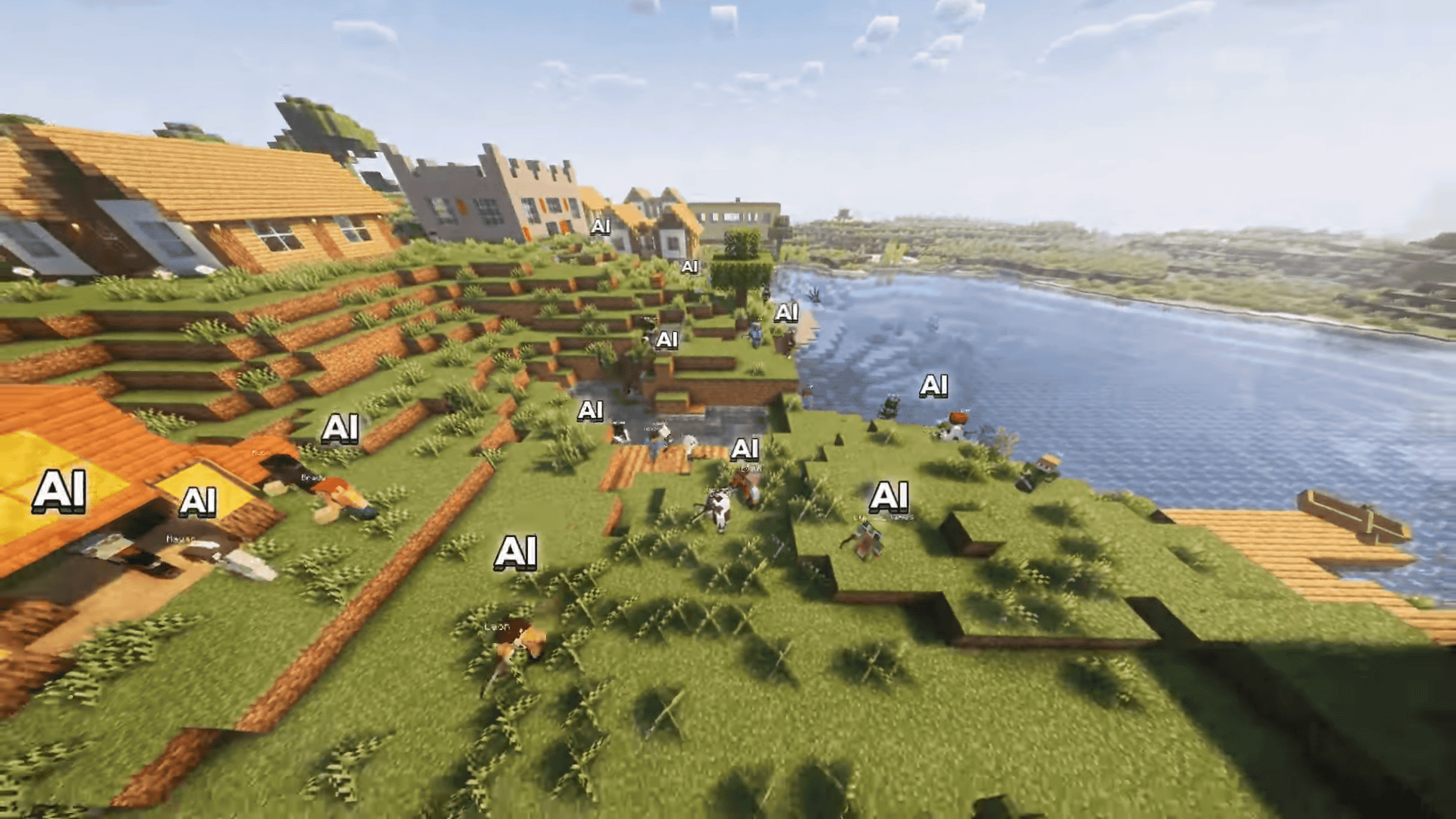
What happens when you put 1,000 so-called AI agents (programs that interact with their environment, collect data, and act autonomously based on that data) on a Minecraft server at the same time – without human intervention, but with clear rules and tasks?
That’s exactly what AI research company Altera.ai wanted to find out with an unusual project.
In the open game world of Project Sid, a functioning society emerged in which the programs began to forge alliances, collect resources, and establish gemstones as a common currency for trade.
Some agents even took on the role of priests and tried to influence other villagers through bribery.
Project Sid was launched by Dr. Robert Yang, a neuroscientist and former professor at the renowned MIT university. Although the experiment took place in the world of Minecraft, the team aims to transfer the findings to other areas.
“Even though we’re starting with games, we’re solving the most profound problems agents face: cohesion, cooperation between multiple agents, and long-term progression. Sid starts in Minecraft, but we’re already going beyond that.”
The research continues
Project Sid is by no means the only or even the first attempt to give AI agents free rein in a game. In AI Town, autonomous AI characters communicate with human players via text input.
As early as 2023, Stanford University published a study on the Smallville project. In it, 25 AI agents lived in a virtual city – complete with their own personality traits and memories.
The artificial inhabitants quickly began to interact with each other, even planning a Valentine’s Day celebration on their own and displaying surprisingly human behavior.
The source code for Smallville was made publicly available. Since then, other AI demos have been created that explore the interplay between artificial intelligence and simulated worlds – with the aim of making social interactions in digital environments more realistic and autonomous in the future.
AI masters Minecraft without training
Google DeepMind has achieved a breakthrough with its AI system “Dreamer”: the artificial intelligence can successfully find diamonds in Minecraft – without having received any instructions or training on how to play beforehand.
What may seem like a gimmick at first glance is actually a significant advance in AI research.
This is because collecting diamonds in Minecraft is a complex task. Players have to master several steps, cut down trees, make a crafting table, build various tools, and finally dig deep underground for diamonds – a process that takes even experienced players a long time.
According to BGR, the researchers’ approach was to let the artificial intelligence find the solution itself.
According to Danijar Hafner, a computer scientist at Google DeepMind, the AI uses reinforcement learning—a method of learning through trial and error.
According to Hafner, this is a crucial step in enabling AI to understand its physical environment and improve itself without human guidance, because that is exactly what comes into play when exploring Minecraft.
What distinguishes Dreamer from other AI systems is its ability to “imagine” the future.
The AI creates an abstract model of its environment and can thus predict the potential outcomes of various actions before executing them.
The researchers tested Dreamer over nine days, resetting the game world every 30 minutes to ensure that the AI had to adapt to new environments.