
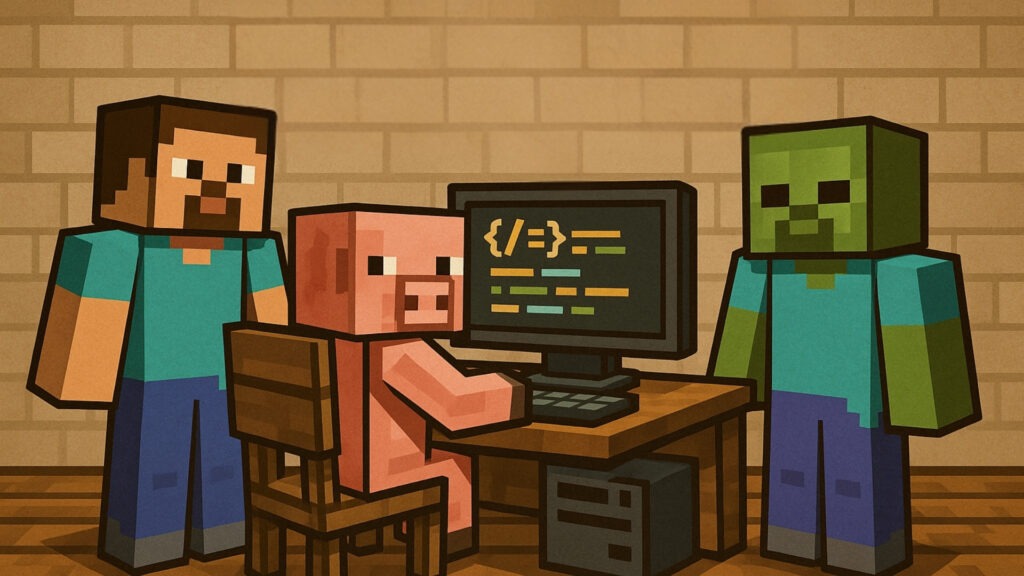
AI in Minecraft: Creative Builds, Automation, and the Future of Intelligent Gameplay
Minecraft is a blank canvas and a million small machines at once. Players still build forts, farms, and pixel art; but increasingly they also bring in AI — to design, to automate, and to surprise.
The game’s scale is enormous: by recent industry tallies Minecraft’s monthly active users are measured in the hundreds of millions, making it one of the most-played games in the world.
Creative builds: from idea to structure in seconds
AI is shortening the time between imagination and in-game architecture. Tools that turn text prompts into schematics can produce viable builds in seconds — everything from small cottages to sprawling castles — ready to import into a server or single-player world.
Some community tools advertise instant “text-to-structure” generation, and research projects such as Generative Design in Minecraft (GDMC) have pushed academic interest in procedural and AI-driven settlement generation for years.
These efforts combine rule-based aesthetics with procedural intelligence so the output feels coherent, functional, and often oddly human.
AI-built structures can be tiny or enormous. Builders use them for prototypes, for inspiration, and sometimes to crowdsource ideas across teams.
The result: faster iteration, bolder experiments, and a lower entry barrier for people who can imagine but cannot pixel-by-pixel design.
Automation: bots, redstone, and relentless productivity
Automation in Minecraft is not new — redstone contraptions and command-block contrivances have automated tasks for a decade — but AI bots take automation to a new level.
Modern Minecraft agents can mine, farm, explore, and even craft by planning sequences of actions rather than following fixed scripts.
That shift matters: it allows bots to adapt to changing worlds, navigate unexpected caves, and carry out long multi-step projects with minimal human supervision.
Recent guides and overviews show how AI bots evolved from simple macros to sophisticated, LLM-driven agents that can parse goals and execute plans.
Automation changes what “playing” means. Want a maintenance bot to keep your base stocked while you build?
You can have one. Want a fleet of miners harvesting deep ores while you design the next expansion? That’s possible too. These agents free players to focus on creative decisions and storytelling rather than repetitive labor.
Security & access: VPNs, servers, and cross-border play
Because Minecraft is global, players often connect to servers and content hosted in different countries. That raises two concerns: security (protecting accounts and sessions) and access (some resources or servers can be geo-restricted).
For both reasons many players use VPNs for safer connections and to reach foreign web resources for mods, tutorials, or community tools.
For example, many creators mention using VeePN to try cross-region access or to encrypt traffic when joining public servers.
Proper use of VPNs can reduce certain attack vectors and sometimes helps access region-locked developer resources or previews.
Mods, marketplaces, and the creator economy
The ecosystem around Minecraft is enormous: mods, plugins, marketplaces, server networks, and content creators.
AI tools are becoming part of that ecosystem — some are offered as paid services, others as free community tools.
Marketplace economics and mod popularity also reflect the size of the audience: with hundreds of millions of players, demand for high-quality, quick-to-deploy content is steady.
AI tools that create skins, maps, or story-driven NPCs are not just curiosities; they are becoming part of how creators monetize their work and how small studios prototype new experiences.
Research & education: embodied learning and generative challenges
Minecraft has been a favorite testbed for AI researchers. Competitions like GDMC ask: can an AI design a believable settlement adapted to terrain and resources?
The question is both technical and artistic — the winning entries blend pathfinding, resource allocation, and style.
More recent research explores embodied AI (agents that learn by acting in the world), and teams have used Minecraft as a sandbox to teach navigation, planning, and soft skills to embodied agents. That means Minecraft isn’t only entertainment; it’s a training ground for real AI ideas.
A practical note: gamers sometimes need to sidestep regional blocks or access specific online curriculum.
This is where VeePN VPN comes into play again. With just a few clicks, you can connect to different servers, and most importantly, securely.
Pop-culture, media coverage, and community narratives
AI stories in Minecraft often attract attention beyond gaming circles. When a player or team creates a functioning chatbot inside the game, or when AI-generated cities fill a server, tech writers and entertainment outlets pick it up.
That crossover brings Minecraft into conversations about pop culture, movies and TV crossovers, and geek culture at large: film reviewers and entertainment news portals sometimes cover big community-built projects, while comic books and streaming shows occasionally reference Minecraft-style creations.
The game’s creative scene feeds broader entertainment news cycles and reminds mainstream media why gaming updates matter to culture at large.
Examples and numbers (quick hits)
- Player scale: reports vary by source, but multiple trackers put Minecraft’s monthly active users in the high hundreds of millions across platforms in recent years, which explains why AI projects built inside the game get so much attention.
- Community AI projects: GDMC and other competitions have run since the late 2010s, focusing on settlement generation and procedural creativity.
- Bot capabilities: modern AI agent toolkits demonstrate multi-step automation (resource collection, crafting, base maintenance), and some research claims automation across hundreds of item types or complex task libraries.
Practical tips for players and creators
- Start small: use AI build generators for idea sparking, then hand-edit the result. AI is fast, but human taste still matters.
- Vet tools before installing: stick to reputable sites and community-vetted downloads. Use security practices (strong passwords, two-factor authentication).
- Plan automation: think about goals (what to automate) and limits (don’t outsource everything — gameplay might become hollow).
- Learn from research: read GDMC entries and embodied-AI posts to understand what’s possible and where creativity still needs human touch.
The near future: collaborative AI and player-led intelligence
Expect AI to become more collaborative: shared AI assistants on servers, language-model-driven NPCs that remember your choices, and smarter builders that can co-design with human inputs.
Players will likely see AI used for accessibility (automatic tutorials, difficulty adaptation), for education (language learning through gameplay), and for creative crossovers with other media — think film- or comic-inspired maps that replicate scenes from popular shows or books, produced with AI assistance.
Closing: intelligent play that still needs people
AI accelerates creation, automates drudgery, and opens doors to research. But the core of Minecraft’s appeal — play, discovery, and human ingenuity — remains. AI is a powerful tool, not a replacement.
Use it to prototype, to explore new aesthetics, and to hand off the boring parts so you can do the interesting ones.
The future of intelligent gameplay will be hybrid: human imagination guided and amplified by machines.