
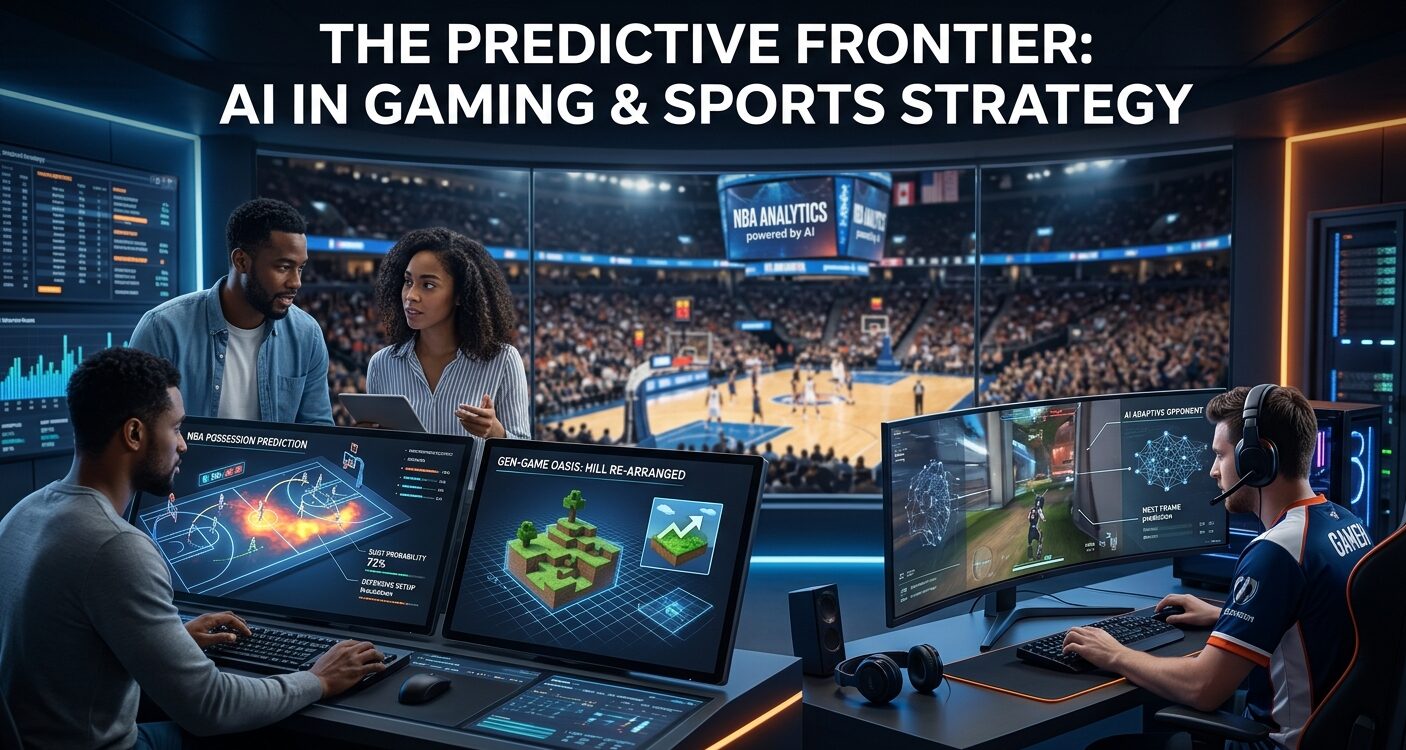
How AI Is Changing Both Gaming and Sports Strategy
Anyone who has played an AI-generated Minecraft world knows the strange moment. You walk forward, turn around, and the landscape behind you has quietly rearranged itself. The hill you just climbed is now a lake.
It’s funny, a little eerie, and a good reminder of what’s really happening. The AI isn’t running a game the way a normal engine does. It’s predicting what the next frame should look like, based on everything it has seen before.
That same idea, learning patterns from huge amounts of footage and data and then predicting what comes next, is now showing up in professional basketball. The goals are different, but the logic is surprisingly close.
Here’s how AI is changing both gaming and sports strategy, where the two overlap, and what both still get wrong.
The shared idea: learn the pattern, predict what’s next
At a basic level, a lot of modern AI works like an extremely well-read guesser. Feed it enough examples, and it learns what usually follows what.
Oasis is a clean example. As TechCrunch explained at its launch, the model was trained on videos of Minecraft gameplay.
It takes in keyboard and mouse input and generates the next frames in real time, simulating the look, rules and physics of the game without a traditional engine behind it.
Sports analytics works on a similar principle. Tracking systems record where every player and the ball are many times per second.
AI models then look for patterns across thousands of possessions: which actions tend to lead to good shots, which defensive setups tend to break down.
Different input, same core move. Show the model enough of the past, and ask it about the next moment.
What AI is doing in games right now?
Generated worlds like Oasis get the headlines, but they’re one part of a bigger picture.
- World models. These generate gameplay directly, frame by frame. Oasis was among the first playable examples. It’s impressive as a proof of concept and rough as a finished game, with low resolution and a short memory for the map.
- Smarter opponents and characters. Developers keep experimenting with AI that adapts to how you play instead of following a fixed script.
- Content generation. Terrain, textures and quests can be produced faster, which helps small teams build bigger worlds.
- Testing and balancing. Automated players can run through a game thousands of times to find bugs and unfair strategies before real players do.
There are open questions too. One that keeps coming up is whether training on a game’s footage raises intellectual-property issues. That debate is far from settled, and it’s worth watching if you care about where AI games go.
Oasis itself is an independent AI experiment that borrows Minecraft-style gameplay as its foundation. It isn’t an official Minecraft product, and it doesn’t pretend to be.
What AI is doing in sports strategy?
Basketball has become one of the clearest places to see applied sports AI. The NBA’s partnership with Amazon Web Services is a good example.
According to AWS Insider’s coverage, the league’s NBA Inside the Game platform turns player-tracking and game data into interactive stats and analytics for broadcasts, the NBA App and NBA.com.
Behind that fan-facing layer, the same kind of data helps teams answer practical questions:
- Shot quality. Not just whether a shot went in, but how hard it was, given the defender and the position.
- Defensive impact. How a player changes opponents’ choices, including actions that never show up in a box score.
- Play recognition. Finding similar plays across thousands of games to see how they usually turn out.
- Lineup decisions. Which combinations of players work together, and why.
The value is speed. A human analyst could eventually notice some of these patterns. AI can find them across a whole season in minutes, and then a coach decides what to do about them.
Where gaming and sports strategy overlap?
Put the two side by side and the similarities add up quickly:
- Both are about simulation. Teams use models to test matchups before they happen. Games build worlds to test your decisions.
- Both depend on pattern recognition. Good players, human or AI, notice habits and exploit them.
- Both reward adaptation. A model that can’t adjust to what’s in front of it gets beaten. So does a team.
- Both are personal at their best. A custom practice plan or a world built around your style works better than a one-size-fits-all approach.
There’s also a lesson hidden in the Oasis “forgetting” problem. When you turn around and the map has changed, that’s the model losing track of context. Sports models have the same weakness in a different form.
Put them in a situation they haven’t seen much, like an unusual lineup or a rare game scenario, and their predictions get shaky.
What both still get wrong?
The excitement around AI can hide some real limits. These are worth keeping in mind whether you’re playing or watching:
- Short memory and weak context. Models can lose the thread, whether that’s a Minecraft hill or a player’s role on a specific team.
- Dependence on the training data. A model only knows what it has seen. Rare events and new styles of play are blind spots.
- Confidence without understanding. AI can produce a smooth answer that sounds right and isn’t.
- Creativity. It’s good at remixing patterns and weaker at truly new ideas, like the first player to rethink how a position is played.
- Black boxes. Fans and players often can’t see how a metric or a generated world was produced, which makes it hard to trust blindly.
What you can do with this as a player or fan?
You don’t need to be an engineer to benefit from any of this. A few simple moves help:
- Play with it and notice the seams. Spend time in an AI-generated world like Oasis and pay attention to what it gets right and what falls apart. You’ll learn more about how these models work than any explainer can teach.
- Treat AI stats as a starting point. When a new basketball metric shows up on a broadcast, ask what it measures and what it might miss.
- Compare the model to your own eyes. If the numbers say a player is great and you watch him struggle, figure out which one is wrong.
- Look for the human decision. In both fields, the interesting part is what a person does with the output.
- Keep following the real thing. For the basketball side, a daily read like Basketballloop helps connect the new analytics to the games and storylines behind them.
Keeping humans in charge
The most important point is also the simplest. In neither gaming nor sports does AI replace the person who has to decide what matters.
A coach still chooses whether to trust a number in a tense fourth quarter. A player still decides whether to take the shot.
A gamer still chooses what to build, where to explore and when something has stopped being fun.
AI is excellent at offering options. Judgment is still a human job.
Where this is heading?
Expect both worlds to get more convincing. Generated games will likely improve in resolution, consistency and memory.
Sports analytics will keep moving from the back office to the broadcast, with more AI-driven context shown to fans during live games.
For anyone who loves games, sports or both, that’s a fun time to pay attention. The tools are getting better, but the questions are the same ones people have always asked: what’s happening, what happens next, and what should I do about it?
AI is just a faster way to start asking.