
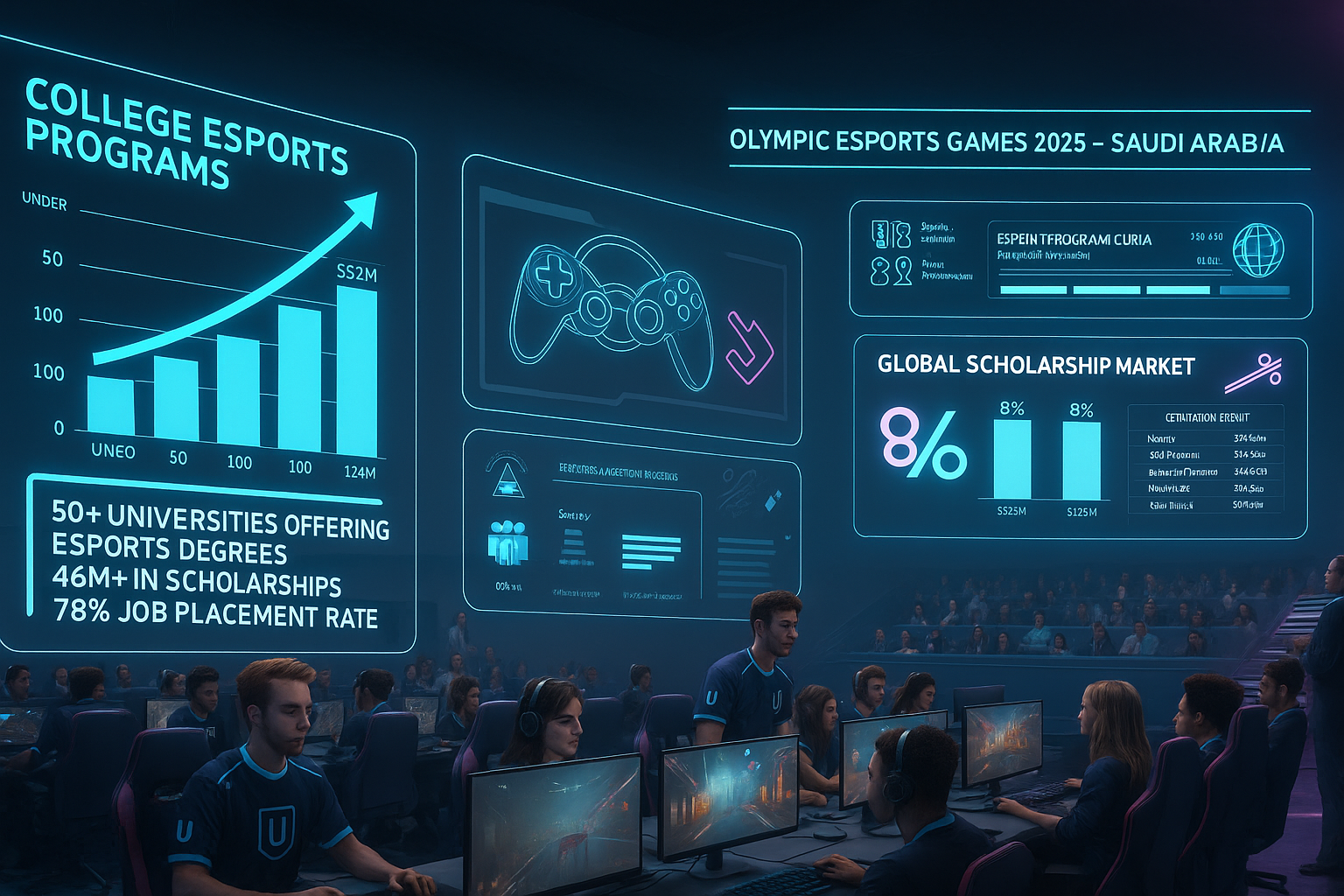
College Esports Program Growth Statistics (2025)
The collegiate esports landscape has undergone a dramatic transformation over the past several years, evolving from informal gaming clubs into fully recognized varsity programs with significant institutional backing. Universities across North America and beyond now invest millions in state-of-the-art gaming facilities, scholarship programs, and academic curricula designed to prepare students for careers in the rapidly expanding global esports industry. This comprehensive analysis examines the latest college esports program growth statistics for 2025, providing verified data on program expansion, scholarship funding, market trends, and institutional investments that define the current state of collegiate competitive gaming.
How Many Colleges Have Esports Programs in 2025
The number of colleges offering varsity esports programs has experienced remarkable growth over recent years. As of 2025, over 260 colleges and universities are members of the National Association of Collegiate Esports, representing a substantial increase from the 130 programs that existed in late 2019. This expansion reflects a doubling of institutional participation within approximately five years, demonstrating the accelerating acceptance of esports as a legitimate collegiate athletic endeavor.
Beyond NACE membership, over 240 U.S. colleges now offer varsity esports programs in total, marking a 37% increase since 2022. These programs collectively represent more than 15,000 student-athletes across North America through NACE and NAECAD combined. The growth trajectory suggests that institutional interest extends far beyond simple recruitment tools, encompassing comprehensive academic and athletic frameworks that mirror traditional sports programs.
College Esports Scholarship Funding and Market Size
Financial support for collegiate esports has grown substantially, with institutions recognizing the value of attracting skilled gamers through competitive scholarship packages. During the 2023-2024 academic year, colleges distributed an estimated $46 million in esports scholarships across North America. Additionally, more than $24 million in scholarship money was awarded specifically to student esports athletes in 2024, demonstrating sustained institutional commitment to competitive gaming programs.
Global University Esports Scholarship Market
The global university esports scholarships market reached $1.24 billion in 2024, with projections indicating growth to $6.16 billion by 2033 at a compound annual growth rate of 18.7%. This substantial market expansion reflects increasing worldwide recognition of esports as both an educational opportunity and potential career pathway for students with competitive gaming skills.
Individual Scholarship Amounts and Ranges
The average esports scholarship in the United States ranges from $1,000 to $6,000 per year, though amounts vary significantly by institution and program level. Most esports scholarships fall within the $500 to $8,000 annual range, with top-tier programs offering considerably more. Some elite programs now provide full-ride scholarships covering tuition, room, board, and gaming equipment, while others offer partial support that can be combined with academic and need-based aid.
| Scholarship Type | Typical Range | Coverage |
|---|---|---|
| Partial Scholarships | $500 – $8,000/year | Partial tuition support |
| Average Programs | $1,000 – $6,000/year | Standard competitive programs |
| Full-Ride Scholarships | Full tuition coverage | Tuition, room, board, equipment |
Collegiate Esports Education Market Growth and Academic Programs
The North American esports education and training market stood at $0.9 billion in 2024 and is projected to grow to $3.8 billion by 2034, representing a compound annual growth rate of 15.7%. This substantial market expansion reflects increasing institutional investment in esports-related academic programming and infrastructure development.
Universities Offering Esports Degrees and Curricula
More than 50 accredited universities now offer esports-related degrees or integrated curricula, providing students with academic pathways in esports management, broadcasting, game development, and related fields. Notable institutions include Boise State University, Full Sail University, and Syracuse University, which have established comprehensive programs combining competitive gaming with academic study. The number of universities offering esports scholarships has increased by 35%, while schools providing esports courses have grown by 25%, demonstrating widespread academic integration of competitive gaming.
Esports Education Statistics 2025
- North American esports education market: $0.9 billion (2024)
- Projected market size by 2034: $3.8 billion
- Market growth rate (CAGR): 15.7%
- Universities offering esports degrees: 50+ institutions
- Increase in universities offering scholarships: 35%
- Increase in schools offering courses: 25%
Global Esports Market Context and Impact on College Programs
The broader global esports industry provides essential context for understanding collegiate program growth. The global esports market was valued at approximately $6.61 billion in 2024, with the United States segment dominating 39% of this revenue. Multiple market research projections suggest continued substantial growth, with estimates ranging from $8.11 billion in 2025 to $48.09 billion by 2034, depending on methodology and market scope definitions.
Esports Viewership and Audience Growth
Global esports viewership reached 544 million in 2024 and is projected to climb to 640 million in 2025, representing approximately 5% annual growth. The audience comprises both core esports enthusiasts and occasional viewers, with estimates suggesting 302 million core viewers and 308 million occasional viewers in 2024. This expanding viewership base creates increased opportunities for collegiate programs to gain visibility and attract sponsorship support, similar to trends observed across major gaming platforms.
Sponsorship and Advertising Revenue
Sponsorship and advertising revenues are expected to reach $6 billion by 2025, representing substantial growth from $1 billion in 2024. Sponsorships remain the primary revenue stream, contributing approximately $935 million globally in 2025. This corporate investment in esports creates additional resources and opportunities for collegiate programs, as brands increasingly seek to connect with engaged gaming audiences through university partnerships and tournament sponsorships.
Institutional Infrastructure Investment in College Esports
Universities are making substantial capital investments in dedicated esports facilities that rival traditional athletic infrastructure. These facilities typically feature high-end gaming stations, coaching areas, broadcast capabilities, and spectator spaces designed to support both competitive teams and broader student gaming communities.
Major Facility Developments and Case Studies
Long Beach City College inaugurated the largest esports lab in Southern California in February 2025, investing $2.3 million in 47 Alienware gaming stations, professional coaching setups, and a shoutcaster booth with advanced audiovisual streaming capabilities. This facility represents the scale of institutional commitment to collegiate esports infrastructure. Similar investments are occurring nationwide, with over 70 institutions now providing official varsity status and access to dedicated training facilities for their esports teams.
Other notable facilities include Syracuse University’s 5,800-square-foot Gaming and Esports Center, featuring 24 high-end personal computers and console gaming on multiple systems, along with virtual and augmented reality offerings. The University of Akron operates three state-of-the-art gaming facilities totaling 1,222 square feet, providing dedicated spaces for varsity and recreational teams. These investments demonstrate that esports infrastructure has become a priority for institutions seeking to attract and retain gaming-focused students, paralleling the competitive dynamics seen in console market competition.
Student-Athlete Representation and Organizational Growth
Multiple organizations now serve the collegiate esports ecosystem, providing competitive frameworks, governance structures, and support services for member institutions. The National Association of Collegiate Esports represented over 200 member institutions by late 2022 and has grown to over 260 members by 2025. NACE focuses on promoting varsity collegiate esports programs and ensuring academic eligibility standards for student-athletes.
Unified Collegiate and Conference Structures
Unified Collegiate, which manages leagues including the Midwest Esports Conference, Mid-Atlantic Esports Conference, and Unified Collegiate League, claims over 260 member institutions in 2025. These organizational structures provide competitive platforms, strategic planning support, and different membership tiers to accommodate varying program sizes and institutional ambitions. The expansion of formalized league structures reflects the professionalization of collegiate esports, moving from student-run clubs to institutionally recognized varsity programs with dedicated staff, facilities, and budgets.
Popular Esports Titles in College Competition
Collegiate esports programs compete across multiple game titles, with institutions typically offering both varsity-level competition and club-level play. The most commonly supported titles include League of Legends, Valorant, Rocket League, Overwatch 2, Super Smash Bros. Ultimate, Counter-Strike, and various fighting games. The specific games offered vary by institution based on student interest, competitive opportunities, and available league structures.
Some programs also support additional titles including Fortnite, Hearthstone, Rainbow Six Siege, NBA 2K, and Mobile Legends: Bang Bang. The diversity of supported games reflects the breadth of the competitive gaming landscape and allows programs to attract students with varying gaming preferences and skill sets. This multi-title approach mirrors the diverse player interests seen across popular gaming communities.
High School Esports Growth and Pipeline Development
High school esports participation in the United States has doubled since 2020, reaching over 200,000 registered players in 2024. This substantial growth in scholastic esports creates a robust pipeline of potential collegiate esports athletes. The expansion of high school programs helps students develop competitive skills earlier, increasing the talent pool available to collegiate programs and contributing to the overall professionalization of the esports pathway from secondary to higher education.
Female Participation and Diversity Initiatives
Female participation in scholastic esports increased to 18% in 2024, up from just 11% in 2021, representing significant progress toward greater gender diversity in competitive gaming. Women now comprise 28% of the esports viewing audience in North America, marking a notable shift from 22% in 2020. Collegiate programs increasingly emphasize diversity initiatives to support women and underrepresented minorities in gaming, creating more inclusive competitive environments and expanding the demographic reach of esports programs.
Career Outcomes and Professional Pathways
Esports job placement rates for graduates of esports programs now exceed 78%, often in media, marketing, or event production roles. This strong placement rate demonstrates that collegiate esports programs successfully prepare students for careers beyond professional competition, encompassing the broader esports industry ecosystem including broadcasting, content creation, team management, event coordination, and game development.
The integration of academic programs with competitive gaming opportunities creates multiple career pathways for students. Whether pursuing professional competition, content creation, esports management, or related fields, graduates of collegiate esports programs benefit from hands-on experience, industry connections, and specialized knowledge that translates to employment opportunities in the rapidly growing esports sector, similar to career development seen across the broader gaming industry.
Global Initiatives and Mainstream Recognition
The first Olympic Esports Games are scheduled for 2025 in Saudi Arabia, providing unprecedented mainstream visibility and legitimacy for competitive gaming. This International Olympic Committee initiative represents a watershed moment for esports recognition, potentially influencing how educational institutions and the broader public perceive competitive gaming as a legitimate athletic pursuit.
Regional Competitive Structures
In March 2024, the University Athletic Association of the Philippines launched its first UAAP Esports Tournament, with eight schools competing in NBA 2K, Valorant, and Mobile Legends: Bang Bang. Similar regional initiatives are developing globally, with universities in Europe and Asia establishing robust esports programs and leading to increased international competition and collaboration opportunities for collegiate teams.
Challenges and Sustainability Considerations
Despite remarkable growth, collegiate esports faces several ongoing challenges that require strategic attention from stakeholders. Governance structures continue to evolve as programs mature, with questions around standardization, competitive integrity, and organizational frameworks requiring ongoing refinement. Most esports companies are exercising caution with investments due to uncertain macroeconomic conditions and the need to achieve profitability, affecting resource availability for collegiate programs.
Player Well-being and Academic Balance
Universities are increasingly recognizing the need for comprehensive support systems for esports athletes, including mental health resources, nutritional guidance, and academic support to ensure students can balance their studies with esports commitments. Maintaining academic eligibility requirements while supporting competitive excellence requires careful program management and institutional resources. Physical health considerations, including ergonomic practices, vision care, and managing extended screen time, also require attention as programs mature.
Long-term Financial Sustainability
While operational budgets vary widely across programs, the overall trend points toward greater investment. However, demonstrating return on investment remains crucial for sustained institutional support. Programs must balance facility costs, coaching salaries, travel expenses, equipment upgrades, and scholarship funding while proving value through student recruitment, retention, engagement, and brand visibility. Strategic planning and financial sustainability represent core challenges that successful programs must address to ensure long-term viability.
Future Projections for Collegiate Esports
Looking ahead to the 2025-2026 academic year and beyond, continued growth in program numbers and student participation appears likely. League structures will further solidify as organizations like NACE and Unified Collegiate refine competitive frameworks and governance models. Investment models are expected to mature with greater focus on demonstrable return on investment, requiring programs to articulate clear value propositions to institutional leadership.
The integration of academic pathways will deepen as more universities develop specialized degree programs in esports management, game design, broadcasting, and related fields. Emerging technologies including artificial intelligence, virtual reality, and enhanced streaming capabilities will create new opportunities for innovation in competitive gaming experiences and spectator engagement. The convergence of esports with traditional education continues accelerating, positioning collegiate esports as a permanent and evolving component of the higher education landscape.
FAQs
How many colleges offer esports scholarships?
Over 260 colleges and universities across North America now offer esports scholarships as of 2025. This number has grown significantly, with a 35% increase in universities offering esports scholarships in recent years. Programs range from small community colleges to major research universities, providing opportunities across diverse institutional types and competitive levels.
What is the average esports scholarship amount?
The average esports scholarship in the United States ranges from $1,000 to $6,000 per year. Most scholarships fall between $500 and $8,000 annually, though amounts vary significantly by institution and program level. Elite programs may offer full-ride scholarships covering tuition, room, board, and gaming equipment, while others provide partial support that can be combined with academic and need-based aid.
Can you get a full ride scholarship for esports?
Yes, some elite collegiate esports programs offer full-ride scholarships that cover tuition, room, board, and gaming equipment. While these comprehensive scholarships are less common than partial awards, highly skilled players at competitive institutions may receive full financial support. The availability of full-ride scholarships depends on institutional resources, program competitiveness, and individual player skill level.
What games do college esports teams compete in?
College esports teams compete across multiple game titles including League of Legends, Valorant, Rocket League, Overwatch 2, Super Smash Bros. Ultimate, Counter-Strike, Fortnite, Hearthstone, Rainbow Six Siege, and various fighting games. The specific titles offered vary by institution based on student interest, competitive opportunities, and available league structures. Most programs support multiple games at both varsity and club levels.
Are there esports degree programs at universities?
More than 50 accredited universities now offer esports-related degrees or integrated curricula. These programs cover areas including esports management, broadcasting, game design, and related fields. Institutions like Boise State University, Full Sail University, and Syracuse University have established comprehensive programs combining competitive gaming with academic study, preparing students for diverse careers in the esports industry.
How much money was distributed in college esports scholarships?
During the 2023-2024 academic year, colleges distributed an estimated $46 million in esports scholarships across North America. Additionally, more than $24 million in scholarship money was awarded specifically to student esports athletes in 2024. The global university esports scholarships market reached $1.24 billion in 2024 and is projected to grow to $6.16 billion by 2033.
What is NACE in college esports?
NACE (National Association of Collegiate Esports) is the largest membership association dedicated to advancing varsity collegiate esports. Founded in 2016, NACE now includes over 260 member institutions across the United States and Canada. The organization promotes varsity esports programs, enforces academic eligibility requirements, and supports the academic success of student-athletes while providing competitive frameworks and governance structures.
How many student-athletes compete in college esports?
Over 15,000 student-athletes are represented through NACE and NAECAD combined across North America as of 2025. This number continues to grow as more institutions establish varsity programs and expand their team rosters. The student-athlete population includes competitors across multiple game titles, competitive levels, and institutional types.
What career opportunities exist for college esports graduates?
Esports job placement rates for program graduates exceed 78%, often in media, marketing, or event production roles. Career pathways include professional competition, content creation, esports management, broadcasting, event coordination, game development, team coaching, and various supporting roles within the esports industry ecosystem. The integration of academic programs with competitive gaming creates diverse employment opportunities.
How has the global esports market grown?
The global esports market was valued at approximately $6.61 billion in 2024, with projections suggesting substantial continued growth. Market estimates range from $8.11 billion in 2025 to potentially $48.09 billion by 2034, depending on methodology. The United States dominates with 39% of global esports revenue. Viewership is projected to reach 640 million globally in 2025, up from 544 million in 2024.
Sources and Citations
- SQ Magazine. (2025). “Esports Statistics 2025: Market Growth, Viewership, and Trends.” https://sqmagazine.co.uk/esports-statistics-2/
- Precedence Research. (2025). “Esports Market Size to Hit Around USD 48.09 Billion By 2034.” https://www.precedenceresearch.com/esports-market
- Unified Gaming. (2025). “The Growth of Collegiate Esports in 2025.” https://uea.gg/news/article/150
- Player Counter. (2025). “College Esports Program Growth Statistics.” https://playercounter.com/college-esports-program-growth-statistics/
- ASO World. (2025). “Global Esports Market Report 2024.” https://asoworld.com/blog/global-esports-market-report-2024/