
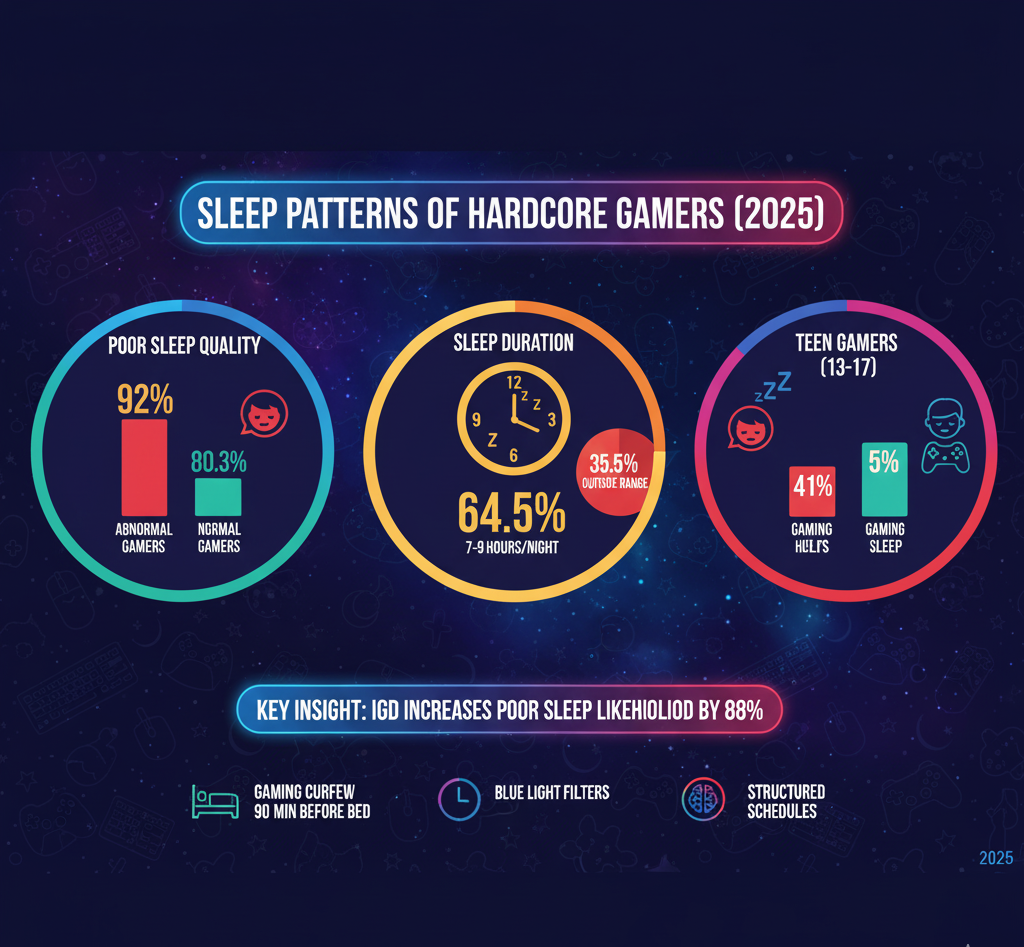
Sleep Patterns of Hardcore Gamers (2025)
Sleep disturbances among gamers have become a pressing health concern as gaming hours rise globally. Recent research reveals significant differences between hardcore and casual players regarding sleep quality, duration, and overall health impacts. Understanding these patterns helps identify risk factors and develop strategies for healthier gaming habits.
Sleep Quality in Hardcore Gamers: Current Statistics
Research conducted in 2024 among medical students shows substantial differences in sleep quality between gaming categories. Those classified as abnormal gamers (engaged, problematic, or addicted) reported poor sleep quality at rates of 92%, compared to 80.3% among normal gamers. This represents a statistically significant difference that highlights the correlation between intensive gaming and sleep disruption.
Poor Sleep Quality: Abnormal vs Normal Gamers
The study involved 356 participants with an average age of 22.5 years, demonstrating that gaming disorder affects sleep quality across young adult populations. Addicted gamers specifically showed longer sleep latency and increased reliance on sleep medication compared to other gaming categories.
Internet Gaming Disorder and Sleep Problems
A comprehensive study of Jordanian university students aged 18-26 found that 15.2% met criteria for Internet Gaming Disorder. Among the total population studied, 64.6% reported poor sleep quality, with IGD significantly predicting sleep problems. The odds ratio of 1.882 indicates that individuals with IGD are nearly twice as likely to experience poor sleep compared to those without the disorder.
Key Finding: Internet Gaming Disorder increases the likelihood of poor sleep quality by 88%, demonstrating a clear relationship between problematic gaming and sleep health.
The connection between gaming addiction and sleep extends beyond simple duration. Players with IGD experience difficulties with sleep onset, frequent nighttime awakenings, and reduced sleep efficiency. These factors compound over time, creating a cycle where poor sleep affects gaming performance and mood, potentially driving increased gaming as a coping mechanism.
How Many Hours Do Hardcore Gamers Sleep?
An international sample of adult gamers revealed average sleep duration of 8.42 hours, with 64.5% consistently achieving the recommended 7-9 hours. However, these seemingly healthy numbers mask important variations within gaming intensity subgroups. The average sleep onset latency was 24.63 minutes, which falls within normal ranges for the general population.
Adult Gamer Sleep Duration Distribution
While these averages suggest adequate sleep, the data reveals that one-third of gamers fall outside healthy sleep duration ranges. Hardcore gamers who engage in competitive or extended gaming sessions typically experience lower sleep efficiency despite spending similar time in bed. Much like how Minecraft player demographics show varied engagement patterns, sleep quality differs significantly based on gaming intensity.
Sleep Patterns of Hardcore Gamers by Game Type
The type of games played significantly influences sleep outcomes. A 2024 systematic review found that casual gaming up to 7 hours per week may not harm sleep quality and could potentially improve it. Conversely, excessive gaming, particularly involving arousing genres like first-person shooters and MMORPGs, consistently delays sleep onset and reduces sleep efficiency.
Competitive gaming creates elevated arousal states that extend the time required to fall asleep. Blue light exposure from displays suppresses melatonin production, while emotional responses triggered during competitive matches create hormonal cascades that interfere with sleep onset. The intensity of gameplay matters more than total gaming hours when examining sleep impact.
Players who engage with AI-generated gaming experiences may experience different arousal patterns compared to traditional competitive gaming. Strategy games and role-playing games permit more gradual disengagement, though extended play sessions still delay sleep onset.
Gaming Before Bedtime: Critical Timing Factors
Studies examining evening gaming timing demonstrate that intense gameplay within two hours of intended sleep time significantly delays sleep onset. The combination of blue light exposure and cognitive stimulation creates a powerful wake-promoting effect that disrupts natural sleep cycles.
Gamers who play competitive matches immediately before attempting sleep experience the longest latencies. The emotional and cognitive activation from competitive gameplay requires extended wind-down periods that delay natural sleep onset mechanisms. Sleep experts recommend establishing a gaming curfew at least 90 minutes before intended bedtime to allow physiological arousal to dissipate.
Teen Gamers and Sleep Disruption
A 2024 Pew Research survey of U.S. teens aged 13-17 reveals that 41% of teen video gamers report that gaming has hurt their sleep, while only 5% say it helps. This perception gap highlights the predominantly negative impact of gaming on adolescent sleep patterns.
Teen Perceptions: Gaming Impact on Sleep
Teen gamers face particular vulnerability to sleep disruption during a critical developmental period when adequate rest remains essential for physical growth, academic performance, and emotional regulation. Late-night gaming sessions, stimulating content, and screen exposure all contribute to this phenomenon.
The preference between multiplayer and single-player gaming also affects sleep patterns, with competitive multiplayer sessions typically creating higher arousal levels that persist after gameplay ends.
Health Implications of Poor Sleep in Gamers
Chronic sleep deprivation among hardcore gamers leads to multiple health concerns beyond immediate tiredness. Reduced sleep duration and quality affect reaction time, decision-making abilities, memory consolidation, and emotional regulation. These impairments create a paradox where gaming performance suffers due to sleep loss, potentially driving players to game more in frustration.
Long-term sleep disruption increases risks for metabolic disorders, cardiovascular problems, and mental health issues. The relationship between gaming and sleep creates a cyclical pattern where poor sleep affects mood and stress levels, leading some individuals to use gaming as an escape or coping mechanism, which further disrupts sleep.
Similar to how content creators manage streaming schedules, professional gamers must balance performance demands with adequate rest. The competitive gaming industry increasingly recognizes sleep as a critical factor in maintaining peak performance and preventing burnout.
Strategies for Better Sleep in Gaming Communities
Implementing structured gaming schedules helps separate gaming time from sleep preparation. Setting firm cutoff times at least 90 minutes before bed allows for necessary wind-down periods. Using blue light filtering software or glasses during evening gaming sessions can reduce melatonin suppression.
Creating distinct boundaries between gaming spaces and sleeping areas reinforces mental associations between locations and activities. Avoiding stimulating competitive matches in the hours before bed favors lower-intensity single-player experiences or non-gaming relaxation activities.
The growing awareness within gaming communities about player health has led to more discussions about maintaining balance. Professional teams now often include sleep coaches and wellness programs as standard components of player development.
FAQs
What are the sleep patterns of hardcore gamers?
Hardcore gamers average 8.42 hours of sleep with 24.63-minute onset latency, though 92% of abnormal gamers report poor sleep quality compared to 80.3% of normal gamers, indicating significant sleep disruption.
How does gaming affect sleep in teenagers?
41% of teen gamers report gaming hurts their sleep while only 5% say it helps. Late-night sessions and screen exposure disrupt natural sleep cycles during critical developmental periods.
Does game type influence sleep quality?
Yes. Casual gaming under 7 hours weekly may not harm sleep, but excessive arousing games like shooters and MMORPGs delay sleep onset and reduce sleep efficiency significantly.
What is the connection between gaming disorder and sleep?
Internet Gaming Disorder increases poor sleep odds by 1.88 times. Affected individuals experience longer sleep latency, frequent awakenings, reduced efficiency, and greater dependence on sleep medication.
When should gamers stop playing before bed?
Experts recommend stopping intense gaming at least 90 minutes before bedtime. This allows physiological arousal to dissipate and permits melatonin production to support natural sleep onset.
Citations
- Alghamdi, F. A. D., et al. (2024). “Video Game Addiction and its Relationship with Sleep Quality among Medical Students.” Journal of Epidemiology and Global Health, 14(3), 1122-1129. https://pubmed.ncbi.nlm.nih.gov/38896209/
- Al-Khawaldeh, O., et al. (2024). “Internet Gaming Disorder and Sleep Quality among Jordanian University Students: A Cross-sectional Study.” Clinical Practice and Epidemiology in Mental Health. https://pmc.ncbi.nlm.nih.gov/articles/PMC11748057/
- Shaffer, K., et al. (2024). “Sleep Characteristics of an International Sample of Adult Gamers.” Sleep Medicine. https://pubmed.ncbi.nlm.nih.gov/38846584/
- Gottfried, J., & Sidoti, O. (2024). “Teens and Video Games Today.” Pew Research Center. https://www.pewresearch.org/internet/2024/05/09/teens-and-video-games-today/